MAREA Official User Guide & Technical Manual
NASA JPL VSOP87 Planetary Ephemeris Theory × 3D WebGL Interactive Celestial Sphere × Physical Gravitational Tidal Simulator
1. System Architecture & Overview
MAREA is a zero-install, browser-based 3D Celestial Sphere & Physical Gravitational Tidal Simulator combining classical astronomical calculation methods with modern orbital ephemeris theory (NASA JPL / VSOP87 secular planetary variation models).
The software executes real-time spherical trigonometry and gravitational potential calculations directly within the user's browser, accurately modeling the three-dimensional celestial coordinates of the Sun, Moon, and classical planets alongside local oceanic tide-generating forces.
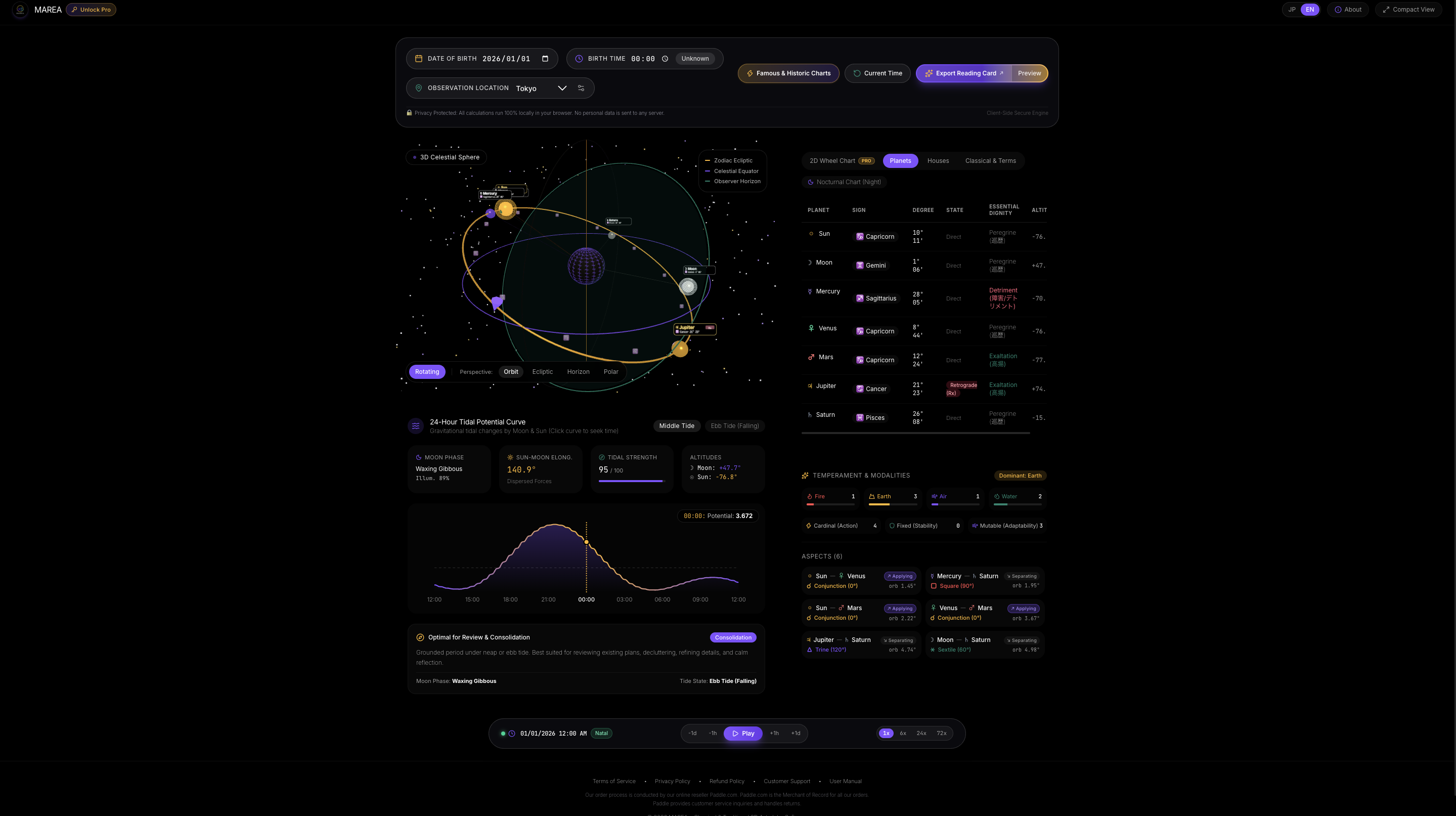
🪐 3D Celestial Sphere
Simultaneously projects Ecliptic, Celestial Equator, Horizon, and Meridian frames into an interactive 3D WebGL space.
🌊 Physical Tidal Dynamics
Computes the 24-hour composite gravitational potential vector of the Moon and Sun to model Spring and Neap tidal waveforms.
🔒 Zero-Knowledge Local
Zero external data transmission. All astronomical calculations and graphical renders occur strictly inside client-side memory.
2. Navigation Header & Location Setup
The top navigation bar consolidates observer location configuration (latitude, longitude, timezone), real-time date/time readouts, full-screen presentation mode, and multilingual toggles.

📍 Geographic Observer Coordinates
Select standard global cities (Tokyo, London, New York, Paris, Cairo, etc.) or input custom geographic latitude and longitude with 0.0001° decimal precision and UTC timezone offset.
🖥️ Presentation Fullscreen Mode
Click the "Fullscreen" button to remove browser UI chrome for clean presentation on lecture projectors or external high-resolution monitors.
3. 3D Celestial Sphere Simulator
Powered by WebGL 2.0 and Three.js, the 3D celestial sphere accurately reproduces geocentric spherical coordinates centered on the terrestrial observer. High-DPI Retina texture rendering and billboarded planetary glyphs ensure crisp visual clarity.
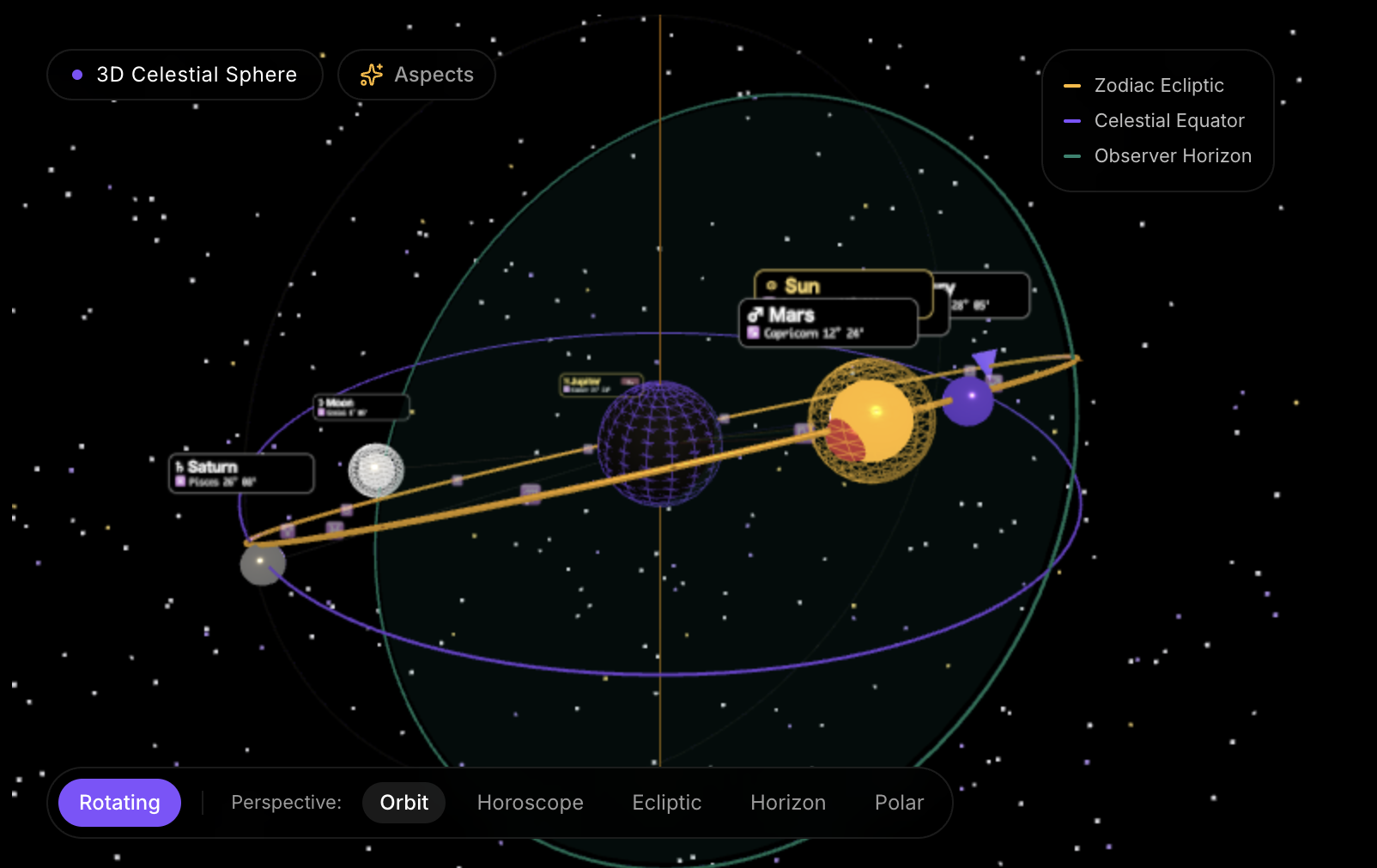
- Orbit Rotation (Left-click Drag / Touch Swipe): Rotate the celestial sphere across 360 degrees to observe planetary positions from any spatial angle.
- Zoom (Mouse Wheel / Pinch): Smoothly zoom between close-up terrestrial perspective and wide-angle orbital overview.
- Day / Night Sect Lighting: Dynamically adjusts ambient illumination based on whether the Sun is above or below the local mathematical horizon.
4. Landmark Astronomical Presets Deck
The preset deck at the top of the interface provides instant one-click access to 8 landmark astronomical timestamps across history, allowing immediate exploration of celestial alignments and tidal curves.

🏛️ Classical & Seasonal Benchmarks
Explore Vernal Equinox, Solstices, heliacal risings, and pivotal scientific milestones such as Galileo's telescopic discoveries (1609).
🌌 Planetary Alignments (Great Conjunctions)
Instantly examine rare orbital alignments, such as Jupiter-Saturn Great Conjunctions, in a full 3D interactive coordinate frame.
5. Ephemeris Coordinates Table
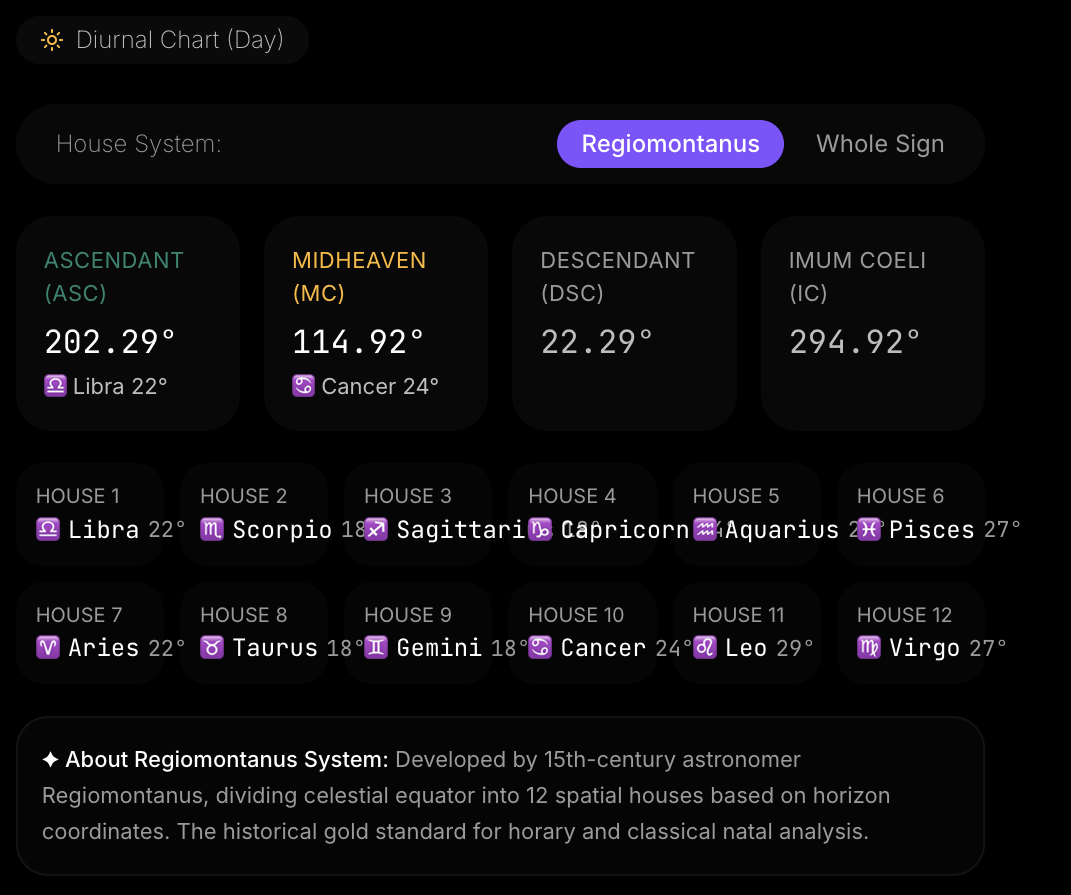
Calculates and tabulates comprehensive astrometric metrics for the 7 classical celestial bodies: Sun (☉), Moon (☽), Mercury (☿), Venus (♀), Mars (♂), Jupiter (♃), and Saturn (♄).
| Parameter | Format Example | Astronomical Definition |
|---|---|---|
| Ecliptic Longitude | Sign + Deg/Min/Sec (e.g., ♈ 15°24'12") | Angular distance along the Ecliptic plane relative to the Vernal Equinox (0°). |
| RA / Declination | Hours:Min:Sec / Deg:Min:Sec | Equatorial coordinate projection relative to the Celestial Equator. |
| House Cusp Index | 1st – 12th House | Local spatial sector relative to the observer's horizon and meridian. |
| Motion State | Direct / Retrograde (℞) | Apparent geocentric angular velocity along the ecliptic. |
6. House Systems & Horizon Cusps
Using the observer's geographic coordinates and local sidereal time, the simulator derives cardinal axes—Ascendant (ASC), Midheaven (MC), Descendant (DSC), and Imum Coeli (IC)—alongside the 12 house boundaries.
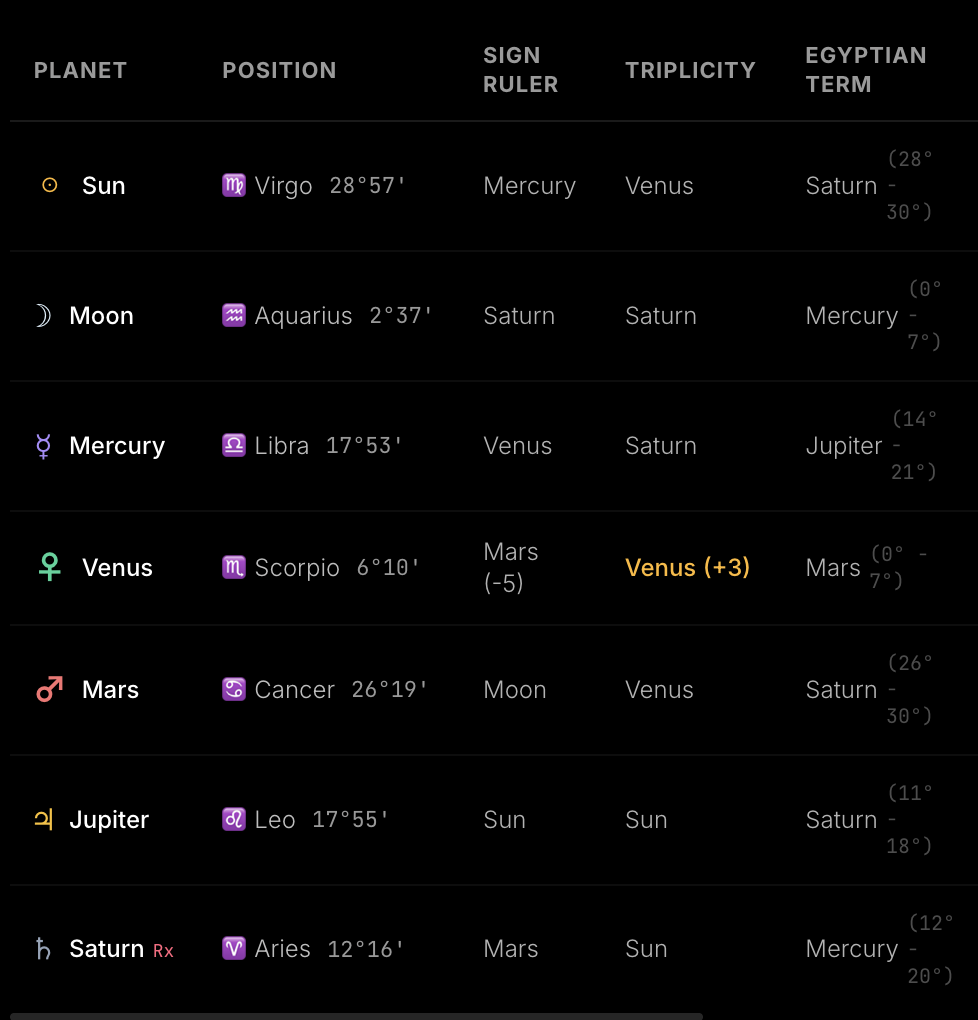
📐 Whole Sign House System
Classical Hellenistic method: the entire zodiac sign containing the Ascendant is designated as the 1st House, with each consecutive sign spanning exactly 30°.
🏛️ Regiomontanus House System
Medieval/Renaissance spatial division: divides the Celestial Equator into 30° sectors from the eastern horizon and projects them onto the Ecliptic.
7. Classical Dignities & Egyptian Terms
Evaluates essential planetary states and term boundaries based on classical Ptolemaic and Hellenistic astronomical frameworks.
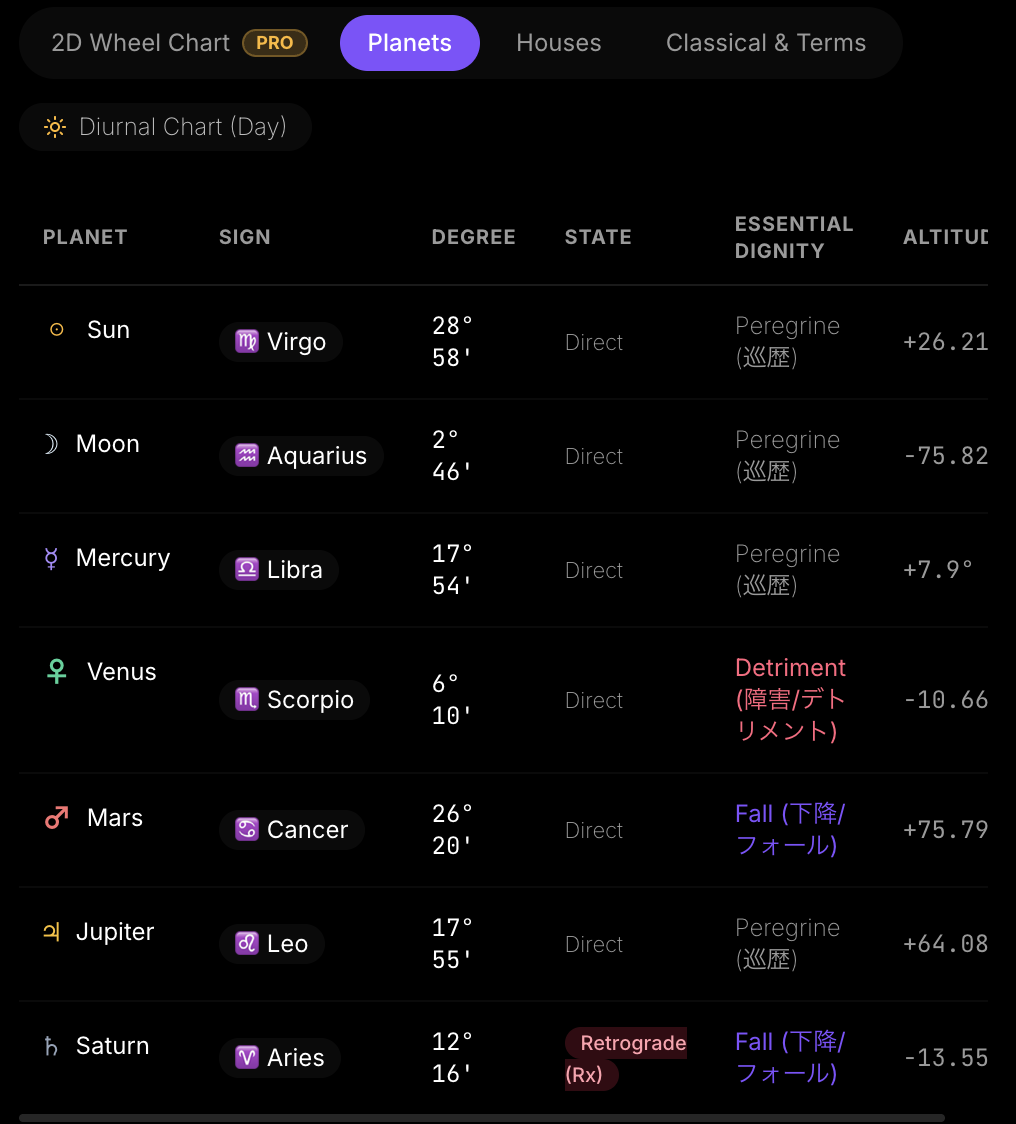
| Essential Dignity | Standard Score | Formal Definition |
|---|---|---|
| Domicile (Ruler) | +5 | Planet positioned within its naturally governed zodiac sign. |
| Exaltation | +4 | Zodiac sign where the planet achieves optimal structural expression. |
| Detriment | -5 | Planet located opposite (180°) its domicile sign. |
| Fall | -4 | Planet located opposite (180°) its exaltation sign. |
| Peregrine | 0 | Planet holding no major dignity scores in its current degree. |
8. Aspect Harmonics & Geometry
Detects angular geometric relationships formed between planetary pairs along the ecliptic circle, calculating precise angular separation, allowable orb deviations, and applying/separating dynamics.
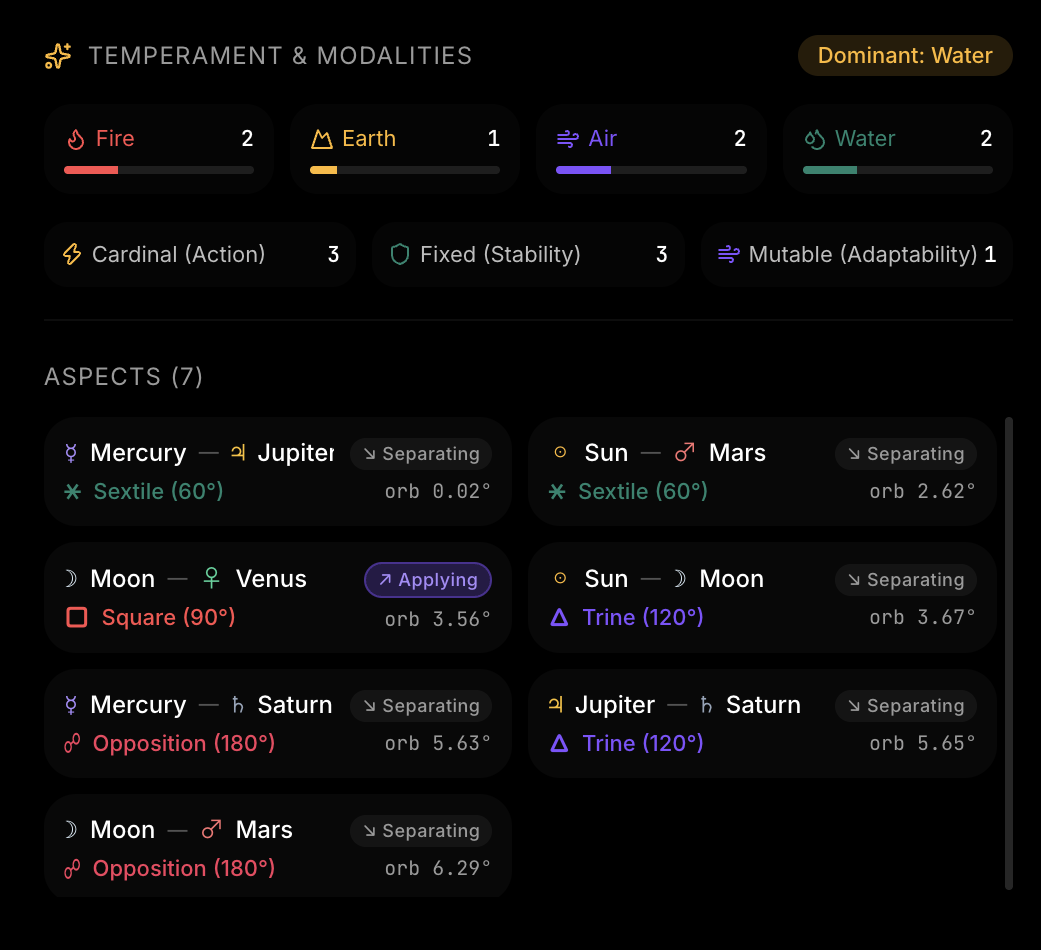
📐 Ptolemaic Major Aspects
Computes Conjunction (0°), Sextile (60°), Square (90°), Trine (120°), and Opposition (180°) with precise decimal degree deviations.
⚡ Applying vs. Separating Dynamics
Compares relative angular velocities to classify whether planets are converging toward exact aspect (Applying) or moving apart (Separating).
9. 24-Hour Gravitational Tidal Curve
Models the combined gravitational force vectors of the Moon and Sun acting on Earth's oceans over a 24-hour diurnal cycle, generating the continuous physical tidal potential wave (Marea Curve).
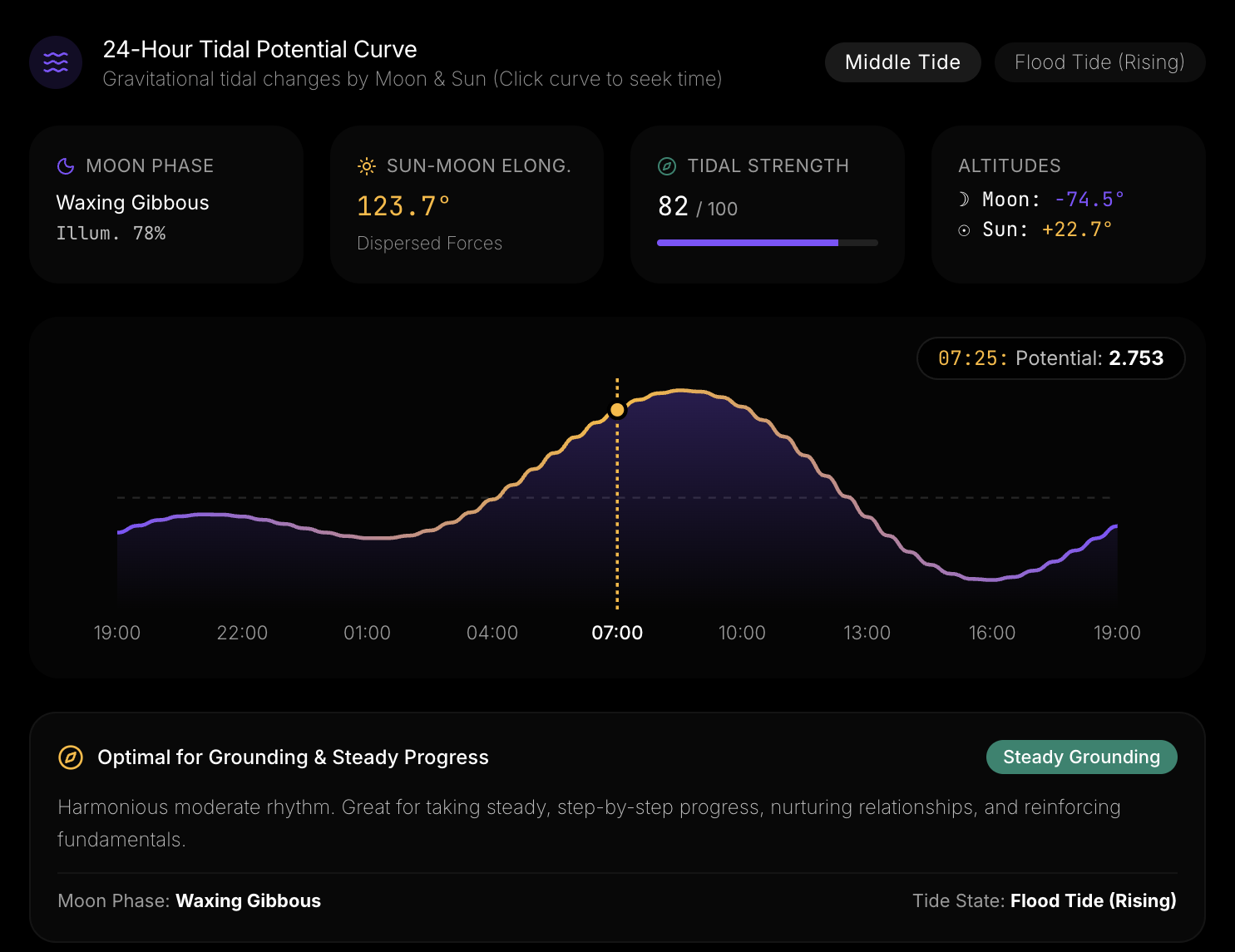
- Spring Tide (Syzygy): During New Moon and Full Moon alignments, lunar and solar gravitational vectors reinforce each other, yielding maximum tidal amplitudes.
- Neap Tide (Quadrature): During First and Third Quarter moons, orthogonal (90°) gravitational vectors cancel out, dampening tidal amplitude.
- Interactive Scrubbing: Click any point on the 24-hour tidal timeline to immediately jump the 3D celestial sphere to that exact timestamp.
10. Real-Time Tracking & Simulation
The bottom time control deck enables live clock synchronization, manual timestamp entry, and fluid forward/backward simulation across customizable time steps.

⏱️ Live Clock Synchronization
Click "Now" to synchronize with device time, updating 3D planetary positions and tidal vectors every second.
⏩ Variable Step Intervals
Simulate motion across 1-minute, 1-hour, 1-day, 1-synodic month, or 1-tropical year increments with smooth frame interpolation.
⏪ Historical & Future Simulation
Jump to any epoch across historical records or centuries into the future via direct timestamp input.
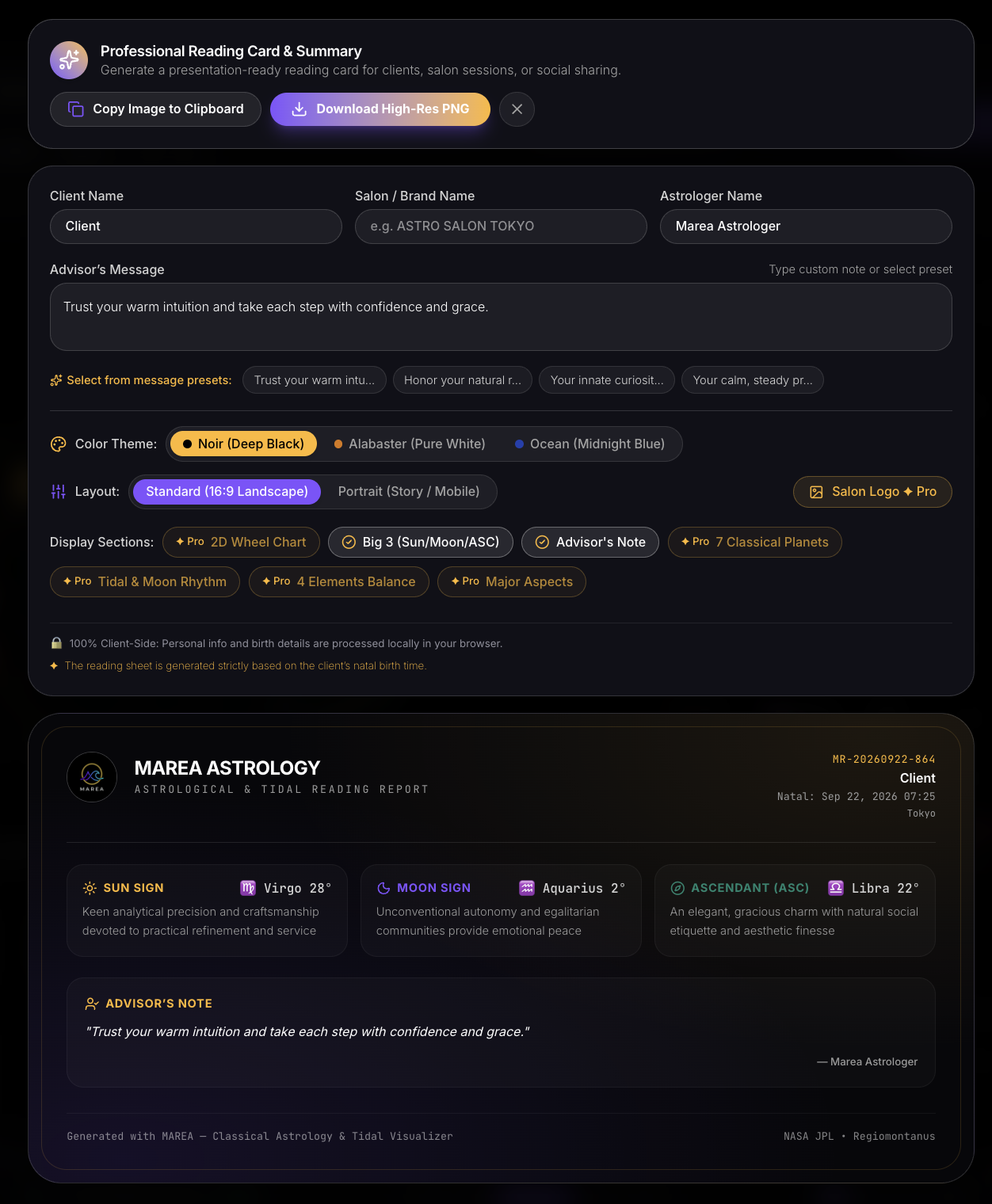
11. Celestial Summary Card Export
Generate and export high-resolution PNG celestial summary cards directly in-browser using HTML5 Canvas rendering. The exported cards integrate planetary coordinates, house cusps, and tidal wave metrics.
12. Technical Specs & Support Policy
💻 System Requirements & Supported Environments
| Specification | Requirement Details |
|---|---|
| Supported Browsers | Google Chrome (v90+), Apple Safari (v14+), Microsoft Edge (v90+), Mozilla Firefox (v88+), Brave |
| Operating Systems | macOS (Sonoma, Ventura, Monterey), Windows 10/11, iPadOS, iOS (iPhone), Android, Linux |
| Graphics Hardware | WebGL 1.0 or 2.0 capable GPU (Standard across 99.9% of devices manufactured within the last 10 years) |
| Installation | Zero installation required (Runs directly inside any modern web browser with offline caching) |
📬 Customer Support & Inquiries
Our dedicated engineering team is here to assist researchers, educators, and users with technical guidance and software support.
- Technical Support Email: support@marea-astro.com
- Support SLA Response Time: Guaranteed response within 24 to 48 business hours from our dedicated engineering team.
- Order & Billing Lookup: Self-service order lookup available at paddle.net.
- Refund Policy: Due to the instant delivery nature of cryptographic digital license keys, all sales are final once delivered. Please test all features with the Free Edition prior to purchase (read full details in our Refund Policy).